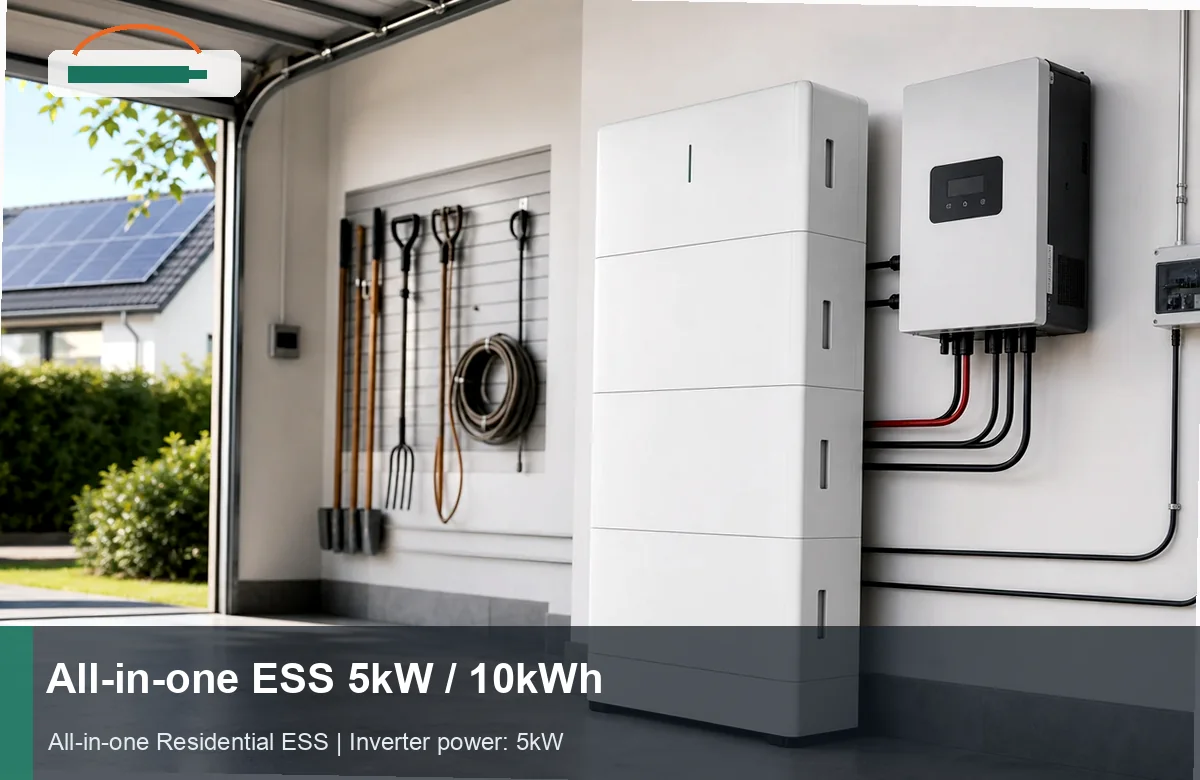
Residential Energy Storage / All-in-one Residential ESS
All-in-one ESS 5kW / 10kWh
All-in-one wall-mounted residential ESS combining 5kW inverter and modular battery capacity.
Inverter power5kWNominal voltage400VProtectionIP65
 Spire ESSHangzhou Xiangcai Network Technology Co., Ltd.
Residential storage sizing
Three routes to a 10kWh residential battery, how to verify the size fits the buyer's load and backup hours, and what to put in an RFQ.
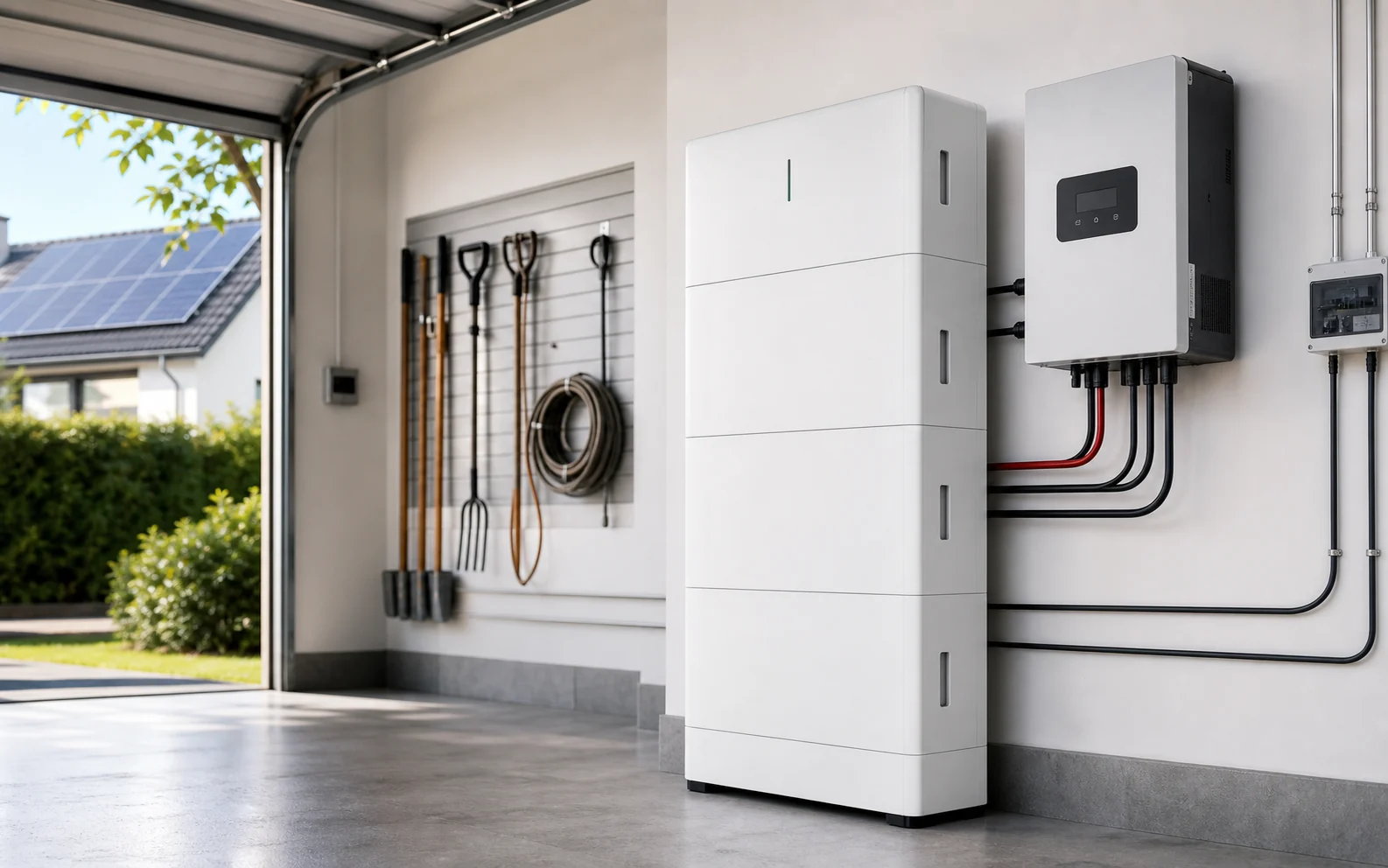
Ten kilowatt-hours has become the most-requested residential storage band. It sits above entry-level 5kWh systems that struggle to cover overnight loads and below the 15 to 20kWh tier that most single-family homes do not need. When a homeowner asks for enough storage to run essentials through a power cut or to hold surplus solar through the evening peak, the math usually lands between 8 and 12kWh usable. The nominal 10kWh target gives installers a practical anchor for scoping, quoting, and buying.
The challenge is that there is no single 10kWh product. Depending on the buyer's space, budget, inverter preference, and whether they want room to expand later, the right hardware looks different on each job. This guide walks the three main routes to roughly 10kWh usable capacity using Spire ESS residential products, explains how to verify the size covers the buyer's load and backup requirement, and lays out what a complete RFQ should include.
What to decide before asking for price.
A typical household running a refrigerator, lighting, a router, phone charging, and a modest television draws roughly 1 to 1.5kW continuously. Over a 6 to 8 hour overnight window that is 6 to 12kWh of actual consumption. Add a morning kettle, an electric shower, or a brief washing-machine cycle and real overnight demand in many homes sits comfortably in the 8 to 12kWh range. Installers who scope carefully find 10kWh nominal covers most buyers without pushing them into a larger, more expensive system they cannot justify.
The All-in-one ESS 5kW / 10kWh integrates the inverter and battery into a single wall-mounted enclosure. The battery is rated at 10kWh nominal and the built-in inverter at 5kW continuous, operating at 400V nominal, with CE-EMC, CE-LVD, UKCA, RoHS, UN38.3, and MSDS references and IP65 protection. For an installer this is the simplest route: one part number, one bracket, one commissioning session. The 72-unit per 20ft GP container reference lets distributors plan import quantities cleanly. Gross weight is referenced at 120kg, so site access and wall load capacity should be confirmed before specifying.
The BluE-PACK5.1 LiFePO4 battery carries 5.12kWh nameplate and 4.6kWh usable at 90% depth of discharge. Two modules give roughly 10.24kWh nameplate and around 9.2kWh usable. The modules use CATL LFP cells, communicate via CAN and RS485, carry an IP65 enclosure reference, and are plug-and-play for modular expansion. The R5KL1-G2 hybrid inverter accepts a 40 to 58V battery range, compatible with the BluE-PACK5.1 nominal 51.2V, and provides 5kW continuous with up to 7.5kW PV input. The two-module stack weighs about 108kg combined (2 x 54kg) and each module is 540 x 490 x 240mm, so the stacking arrangement should be planned with the installer.
The SNE5126LFP-BL is a wall-mounted LiFePO4 battery with 6.656kWh nominal, 51.2V nominal, 80% depth of discharge, and up to 16 parallel strings referenced. At 80% DoD a single unit provides roughly 5.3kWh usable; two units in parallel give around 10.6kWh usable. Communication is CAN and RS485, with more than 5000 cycles at 25 degrees C referenced. The wall-mount format at 1075 x 420 x 140mm per unit is notably shallower than a stacked floor unit, suiting installations with limited floor space. The R5KL1-G2 inverter is a natural pairing at 5kW continuous with a 40 to 58V window. Confirm parallel wiring configuration and BMS compatibility with sales before specifying two units.
A nameplate figure does not answer whether a system lasts the night. Work through four numbers before presenting any option. First, estimate the daily load in kWh. Second, decide how many backup hours the buyer needs, usually 6 to 10 hours for overnight protection and up to 24 to 48 hours for severe-weather resilience. Third, apply depth-of-discharge headroom: the All-in-one and BluE-PACK5.1 are 90% DoD while the SNE5126LFP-BL is 80% DoD, so usable energy is lower than nameplate. Fourth, add a 10 to 20 percent operational reserve so the battery does not regularly cycle to its floor, protecting cycle life. For a buyer who draws 8kWh overnight and wants 10 hours of backup with a 15 percent reserve, the usable requirement is around 9.2kWh, which all three routes cover. A buyer with a heat pump or EV charging should revisit the calculation with actual appliance data.
All three routes work with the R5KL1-G2 hybrid inverter: 5kW continuous, 7.5kW max PV, 100A max charge/discharge, 40 to 58V battery range. The 51.2V nominal of both the BluE-PACK5.1 and the SNE5126LFP-BL sits inside that window, and the All-in-one ESS integrates its own 5kW inverter so no separate pairing is needed. For PV, the 7.5kW maximum input covers most single-family rooftops; buyers with a larger array should review MPPT string design or step up to the R6KL1-G2 or R8KL1-G2. Once route and sizing are set, a complete RFQ includes the product IDs and quantity, the destination market and country, required certifications, the voltage standard (single-phase 230V, split-phase 120/240V, or three-phase 380/400V), packaging or labelling needs, the delivery window, and whether OEM or private label is required. For battery-plus-inverter combinations, confirm BMS communication protocol compatibility so sales can verify the pairing before committing lead times.
| Route | Products | Nameplate energy | Usable energy (est.) | Best-fit buyer |
|---|---|---|---|---|
| All-in-one ESS | All-in-one ESS 5kW / 10kWh | 10kWh | Confirm with sales | Installers wanting one SKU, compact wall-mount, fastest commissioning |
| Two BluE-PACK5.1 + R5KL1-G2 | BluE-PACK5.1 x2, R5KL1-G2 | ~10.24kWh | ~9.2kWh (90% DoD) | Buyers wanting a modular stack with room to add a third module |
| Two SNE5126LFP-BL + R5KL1-G2 | SNE5126LFP-BL x2, R5KL1-G2 | ~13.3kWh | ~10.6kWh (80% DoD) | Installs with limited floor space needing a shallow wall-mount |
Energy figures are estimates based on catalog nameplate and DoD data. Actual usable capacity depends on installation conditions, BMS configuration, and temperature. Confirm with sales before finalising a specification.
Products
Residential Energy Storage / All-in-one Residential ESS
All-in-one wall-mounted residential ESS combining 5kW inverter and modular battery capacity.
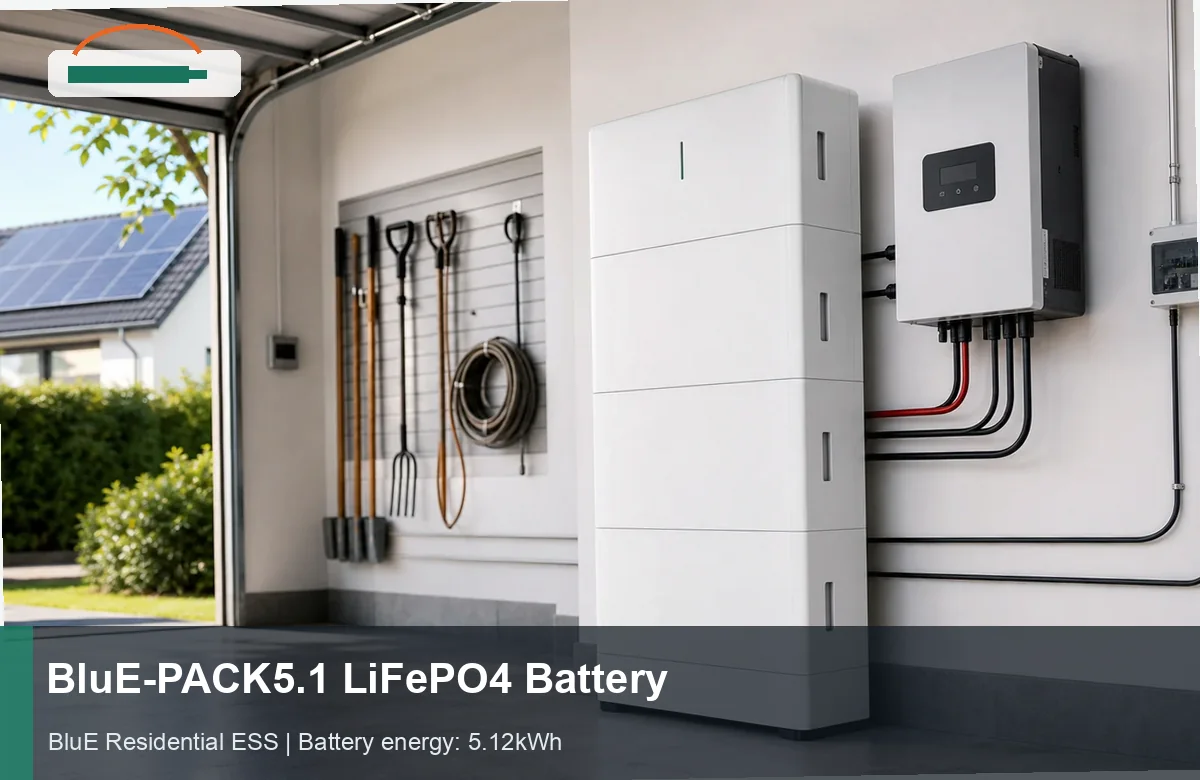
Residential Energy Storage / BluE Residential ESS
5.12kWh LiFePO4 battery module for scalable residential energy storage systems.
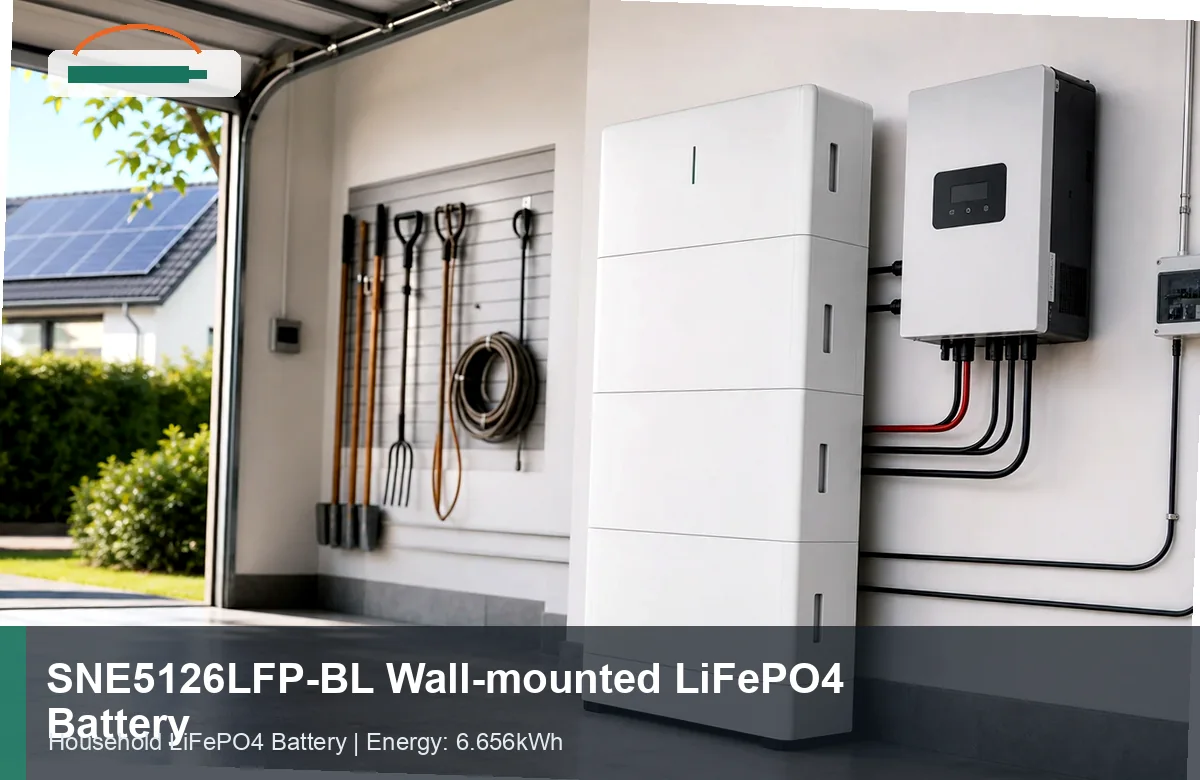
Residential Energy Storage / Household LiFePO4 Battery
6.656kWh wall-mounted LiFePO4 home battery for residential solar storage and backup.
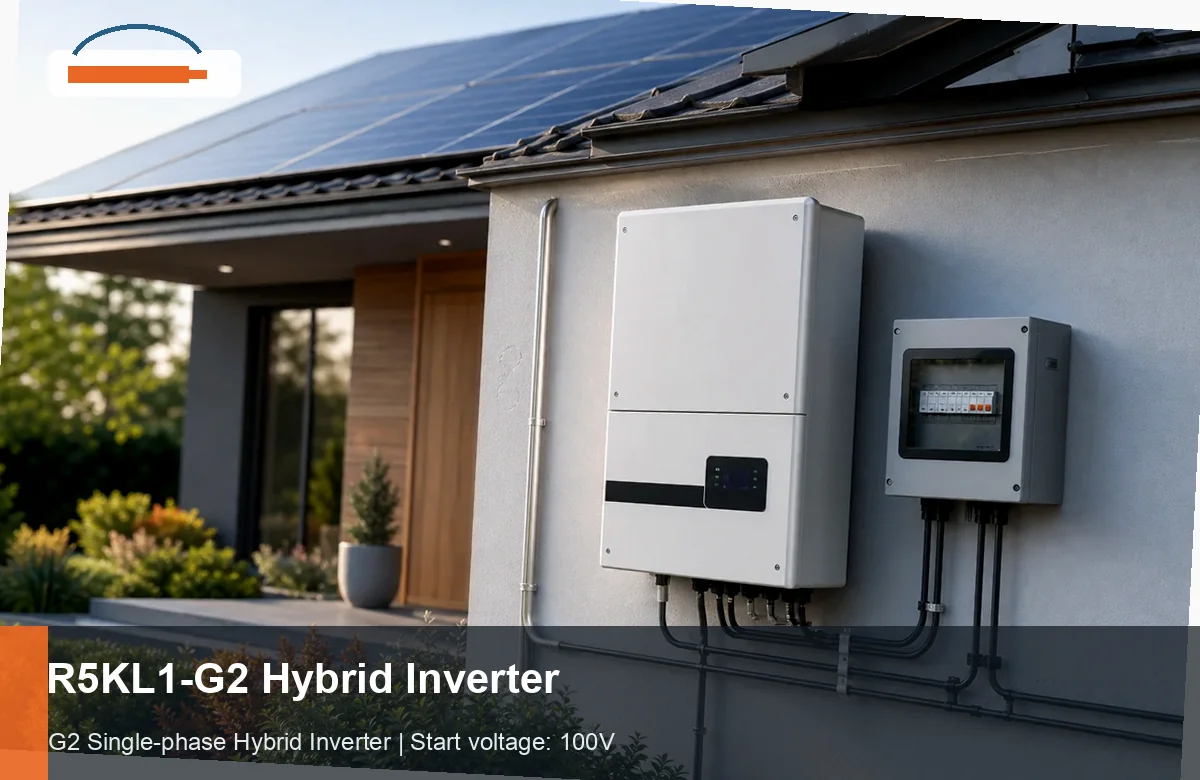
Solar Inverters / G2 Single-phase Hybrid Inverter
Single-phase hybrid inverter range for residential solar storage systems.
Not automatically. The right size depends on the daily load in kWh and the backup hours needed. A home drawing 6kWh overnight may be well served by 7 to 8kWh usable; a home with a heat pump or overnight EV charging may need 15kWh or more. Use the four-step sizing method before specifying.
Nameplate is the total energy in the cells; usable is what can be drawn before the BMS stops discharge to protect the cells. The BluE-PACK5.1 is 5.12kWh nameplate / 4.6kWh usable at 90% DoD; the SNE5126LFP-BL is 6.656kWh nameplate with around 5.3kWh usable at 80% DoD. Always size against usable energy.
The R5KL1-G2 battery window is 40 to 58V and the BluE-PACK5.1 nominal is 51.2V, within range. Two modules give about 10.24kWh nameplate. Confirm the parallel configuration and BMS setup with sales before ordering to validate firmware and wiring for your market.
The catalog references up to 16 parallel strings, which supports a two-unit configuration. Parallel wiring requires matched cells and correct BMS settings, so confirm the arrangement and cabling with sales before specifying, especially where the grid requires certified configurations.
All-in-one ESS 5kW/10kWh references CE-EMC, CE-LVD, UKCA, RoHS, UN38.3, and MSDS; the BluE-PACK5.1 references CE, UN38.3, and MSDS; the SNE5126LFP-BL references CE, IEC62619, UN38.3, and UL; the R5KL1-G2 references CE and RoHS. Confirm market-specific requirements with sales during the RFQ.
The All-in-one ESS 5kW/10kWh fits about 72 units per 20ft GP container at 120kg gross each. For battery-plus-inverter configurations the container mix varies. Include target quantity, destination port, and certification or labelling requirements so sales can prepare a logistics-aware quotation.
AI product assistant